


-134213.jpg)
Switching vs Linear Power Supply: 2026 Engineer's Guide
Date:2026-09-17 02:18:06 Visit:20
When engineers select a power supply architecture, the question is rarely just “Which technology is better?”
The more useful question is:
Which power conversion approach best fits the electrical, thermal, mechanical, acoustic, cost, and application requirements of the system?
The two technologies solve power-conversion problems differently. Switching power supplies are widely used when efficiency, power density, wide input ranges, and higher output power are important. Linear regulation remains useful when low output noise, simple regulation, and a small input-to-output voltage difference are important.
This 2026 Engineer's Guide compares switching and linear power supplies across six practical engineering factors:
Efficiency · Size · Weight · Heat · Noise · Cost
It also looks at real-world design examples and explains when a hybrid switching + linear architecture can make more sense than choosing only one technology.
Switching vs Linear Power Supply: Quick Answer
For a simplified linear-regulator stage, efficiency is approximately:
Efficiency ≈ VOUT / VIN
and the power dissipated in the regulator is approximately:
PLOSS ≈ (VIN − VOUT) × IOUT
By contrast, switching converters can achieve higher efficiency because their switching devices spend much of their operating time in low-loss ON or OFF states rather than continuously dissipating the full voltage difference.
In practical terms:
Choose switching when efficiency, power density, or thermal performance is a major system requirement.
Consider linear regulation when very low output noise or simple low-power regulation is the priority.
Consider a hybrid switching + linear architecture when both efficiency and low noise matter.
Power Supply and Linear Regulator Are Not Exactly the Same
The terms linear power supply and linear regulator are often used interchangeably, but they are not always identical.
A traditional linear power supply may contain a transformer, rectifier, filter and linear regulation stage.
A linear regulator is specifically the stage responsible for regulating voltage.
This distinction is important when engineers compare complete power supplies rather than individual regulation circuits.
Real-World Engineering Example: When Both Are Important
Some systems need both efficiency and low noise.
In that case, engineers can combine the two technologies.
A typical architecture uses a switching converter for the main voltage conversion and a linear regulator for final low-noise regulation.
The switching stage handles efficient power conversion.
The linear stage provides additional low-noise regulation close to the sensitive load.
This approach can be useful in:
-
Measurement equipment
-
Mixed-signal systems
-
RF equipment
-
Communication systems
-
Precision analog circuits
This is an important reminder that switching and linear technologies do not always need to compete with each other.
They can also work together.
Real-World Engineering Example: Industrial Equipment
Consider an industrial control system that requires a regulated DC output and operates continuously.
The main engineering concerns may include:
-
Continuous operating time
-
Thermal performance
-
Limited enclosure space
-
Stable output voltage
-
Energy consumption
-
Reliability
In this situation, switching technology is often a practical choice because efficiency and power density become important system-level factors.
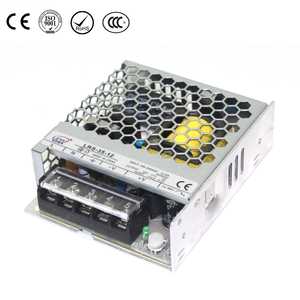
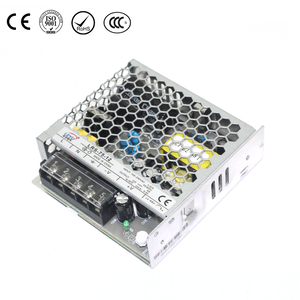
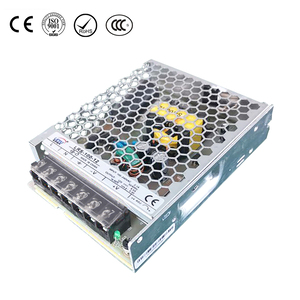
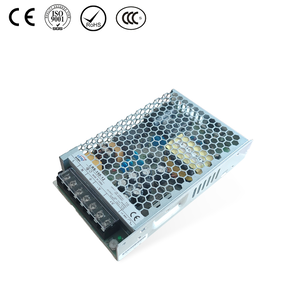
For example, LEYU's LRS series provides enclosed switching power supply solutions for industrial and electronic equipment where compact construction and regulated DC output are required.
Real-World Engineering Example: Low-Noise Electronics
Now consider a different application.
Suppose the equipment contains a sensitive analog circuit and has relatively low current requirements.
The priorities may be:
-
Very low output noise
-
Stable regulation
-
Low ripple
-
Simple power architecture
In this type of application, linear regulation can be attractive.
The goal is not maximum efficiency at any cost. The goal is to meet the requirements of the sensitive circuit.
How Should Engineers Choose?
A practical selection process can start with six questions.
1. How much output power is required?
Higher output power usually increases the importance of efficiency and thermal management.
2. How large is the input-to-output voltage difference?
A large voltage difference can significantly increase heat generation in a linear regulator.
3. How much thermal capacity does the equipment have?
Consider ambient temperature, enclosure size, airflow and cooling method.
4. How sensitive is the load to electrical noise?
Determine whether ripple or electromagnetic interference could affect system performance.
5. How much space and weight are available?
Consider the size of the complete power solution rather than only the main regulator.
6. What is the total cost target?
Include energy consumption, thermal design, mechanical requirements and development effort in the comparison.
Switching vs Linear Power Supply for Different Applications
There is no single technology that is ideal for every application.
Applications Where Switching Is Often Considered
- Industrial automation
- Control equipment
- LED systems
- Communication equipment
- Embedded systems
- Higher-power electronic equipment
- Compact equipment
Applications Where Linear Regulation May Be Considered
- Low-noise analog circuits
- Precision measurement
- Sensitive signal processing
- Low-current regulation
- Applications with a small input-to-output voltage difference
Applications That May Benefit from a Hybrid Approach
- Mixed-signal equipment
- Precision measurement systems
- RF equipment
- Communication systems
- Noise-sensitive control systems
