


-134213.jpg)
Pure Sine Wave vs Modified Sine Wave Inverter: Which Should You Choose?
Date:2026-09-27 03:03:36 Visit:62
When choosing an inverter, one of the first decisions is whether to use a pure sine wave inverter or a modified sine wave inverter.
Both types convert DC power from a battery or other DC source into AC power for electrical appliances. However, the quality of their AC output is different, and that difference can affect equipment compatibility, operating noise, efficiency, heat generation, and total system cost.
For simple loads, a modified sine wave inverter may provide an economical solution. For sensitive electronics, motors, appliances with electronic controls, or systems powering several different types of equipment, a pure sine wave inverter is generally the more compatible option.
This guide explains the differences between pure sine wave vs modified sine wave inverters, where each type is commonly used, and how to choose the right inverter for your application.
What Is a Pure Sine Wave Inverter?
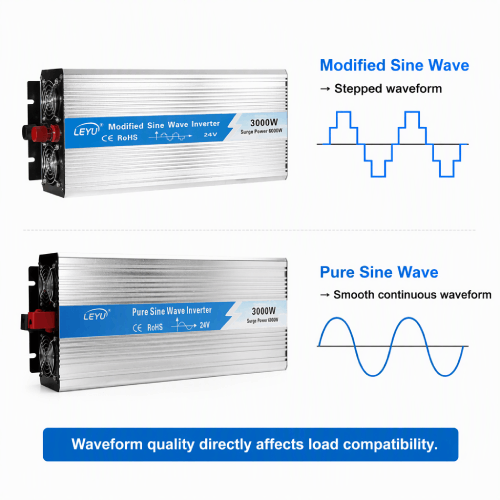
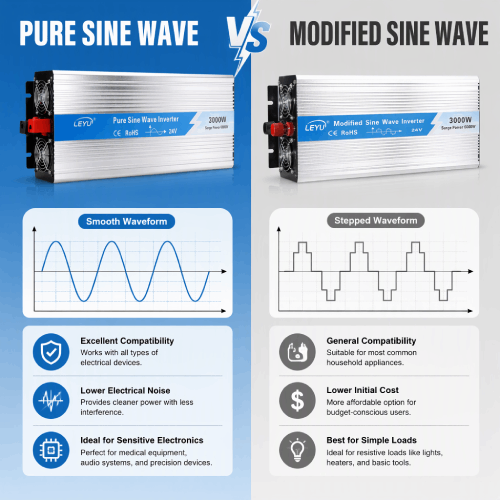
A pure sine wave inverter produces AC voltage with a smooth, continuous waveform that closely resembles the electricity supplied by a conventional utility grid.
Instead of changing voltage abruptly, the waveform rises and falls smoothly through each AC cycle.
This makes pure sine wave output suitable for a wide range of electrical equipment, including devices that depend on precise voltage characteristics, electronic control circuits, motors, timers, and sensitive power supplies.
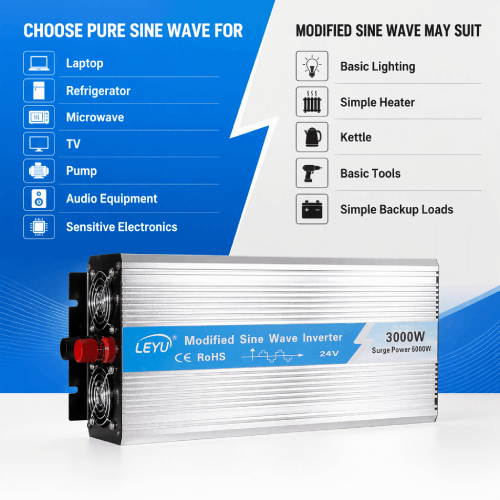
Pure sine wave power is commonly used for:
- Computers and laptops
- TVs and audiovisual equipment
- Refrigerators and freezers
- Microwave ovens
- Pumps and motors
- Variable-speed equipment
- Communication equipment
- Precision electronic devices
- Appliances with digital controls
- Mixed-load off-grid power systems
Pure sine wave output is characterized by low harmonic distortion, which helps inductive loads—such as electric motors and microwave ovens—operate more quietly and reduces unnecessary heat generation.
What Is a Modified Sine Wave Inverter?
A modified sine wave inverter also converts DC into AC, but its output does not follow a smooth sinusoidal curve.
Instead, the voltage changes in a stepped or block-like pattern.
Because the circuit design can be simpler, modified sine wave inverters are generally more affordable and can be practical for applications where the connected equipment does not require high-quality AC power.
Typical applications may include:
- Basic lighting
- Simple resistive heating loads
- Some conventional household appliances
- Basic tools
- Emergency backup systems
- Cost-sensitive off-grid installations with known compatible loads
However, the stepped waveform contains more harmonic content than a pure sine wave. Certain devices may therefore produce additional noise, heat, interference, inaccurate timing, or abnormal operation when powered from modified sine wave output.
Pure Sine Wave vs Modified Sine Wave Inverter: Key Differences
1. Waveform: Smooth vs Stepped
The output of a pure sine wave inverter closely follows a smooth sinusoidal AC waveform.
A modified sine wave inverter approximates AC voltage using several voltage steps.
For many simple electrical loads, this difference may not be immediately noticeable. However, devices that depend on waveform shape, zero-crossing points, motor characteristics, or precise electronic controls can respond differently.
This is one reason inverter selection should be based on the actual load rather than wattage alone.
2. Equipment Compatibility
Compatibility is one of the strongest advantages of a pure sine wave inverter.
Modern electrical equipment increasingly contains:
- Microprocessors
- Digital timers
- Electronic speed controls
- Switch-mode power supplies
- Sensors
- Motor control circuits
- Power-factor-correction circuits
Simple Rule:
If you are not entirely certain about the specific types of internal electronic components in the connected device, choosing a pure sine wave power source offers broader compatibility.
3. Motors, Pumps and Compressors
Motor-driven equipment deserves special attention when comparing modified sine wave vs pure sine wave inverters.
Examples include:
- Refrigerators
- Freezers
- Water pumps
- Fans
- Compressors
- Power tools
- Small industrial motors
Some motors can operate from modified sine wave power, but waveform harmonics can increase electrical and thermal stress in certain applications.
Possible symptoms include:
- Additional humming
- Higher operating temperature
- Increased current draw
- Reduced efficiency
- Lower motor speed
- Difficulty starting
3. Motors, Pumps and Compressors
Motor-driven equipment deserves special attention when comparing modified sine wave vs pure sine wave inverters.
Examples include:
- Refrigerators
- Freezers
- Water pumps
- Fans
- Compressors
- Power tools
- Small industrial motors
Some motors can operate from modified sine wave power, but waveform harmonics can increase electrical and thermal stress in certain applications.
Possible symptoms include:
- Additional humming
- Higher operating temperature
- Increased current draw
- Reduced efficiency
- Lower motor speed
- Difficulty starting
Pure sine wave power supplies typically provide operating conditions that more closely resemble utility AC power, making them the ideal choice when a system frequently powers motors or compressors.
Inrush current during startup is another factor that must be considered.
When starting up, appliances such as refrigerators, water pumps, or compressors may require several times their normal operating power.
Therefore, simply selecting a pure sine wave output is insufficient; the inverter must also be capable of delivering adequate continuous and surge power to the load.
4. Sensitive Electronics
Sensitive electronics are another important reason buyers choose a pure sine wave inverter.
Typical examples include:
- Computers
- Audio equipment
- Communication devices
- Measurement equipment
- Modern televisions
- Electronic control systems
- Equipment with digital clocks or timing circuits
Modified sine wave power can introduce electrical noise and harmonic interference.
Depending on the device, this may appear as:
- Audible buzzing
- Screen interference
- Communication noise
- Unstable operation
- Incorrect timing
- Unexpected shutdown
- Excessive heat
Not every device will experience these problems, but the risk increases when the equipment contains more sophisticated electronics.
5. Noise and Heat
One practical difference users may notice immediately is operating noise.When powered by a modified sine wave output, certain fans, transformers, motors, and audio equipment may produce a noticeable humming sound.
The operating temperature of certain loads may also rise.
6. Cost
Modified sine wave inverters typically offer a significant advantage:A lower initial cost.
If the system powers only simple, straightforward loads and the primary goal is to minimize upfront investment, a modified sine wave inverter may suffice.
Pure sine wave inverters generally come at a higher cost because their power electronics and control designs must be capable of outputting a cleaner AC waveform.
However, the purchase price should not be considered in isolation.
For B2B buyers and system integrators, it is crucial to consider the following factors holistically:
Total System Cost = Inverter Cost + Load Compatibility Costs + Energy Loss Costs + Maintenance Risk Costs + Equipment Downtime Costs
If a low-cost inverter leads to compatibility issues with the customer's equipment, it may not actually be the more cost-effective solution.
What Appliances Need a Pure Sine Wave Inverter?
A pure sine wave inverter should be strongly considered when powering equipment such as:
Refrigerators and Freezers
These normally contain compressors and may have electronic temperature controls.
Both waveform quality and starting surge capacity should be considered.
Microwave Ovens
Microwave ovens contain electrical components that may perform differently on distorted AC power.
Pure sine wave power generally provides more predictable operation.
Computers and IT Equipment
Computers, networking devices, monitors and related electronics are often better suited to clean AC power, particularly in professional or continuously operating installations.
Audio and Communication Equipment
Because modified sine wave output contains greater harmonic content, audio and radio equipment can be more susceptible to interference or audible noise.
Equipment with Electronic Controls
Digital timers, speed controllers, electronic thermostats and certain automated devices may depend on AC waveform characteristics.
Pure sine wave is therefore the safer specification when compatibility is uncertain.
Medical or Safety-Critical Equipment
For medical or other safety-critical equipment, always follow the equipment manufacturer's approved power-source requirements rather than assuming inverter compatibility.
What Can You Run with a Modified Sine Wave Inverter?
Modified sine wave inverters can still be useful where the loads are simple and clearly understood.
Potential applications include:
- Incandescent lighting
- Simple resistive heaters
- Basic kettles
- Some basic power tools
- Simple emergency power systems
- General appliances confirmed by the manufacturer as compatible
Which type of inverter should you choose?
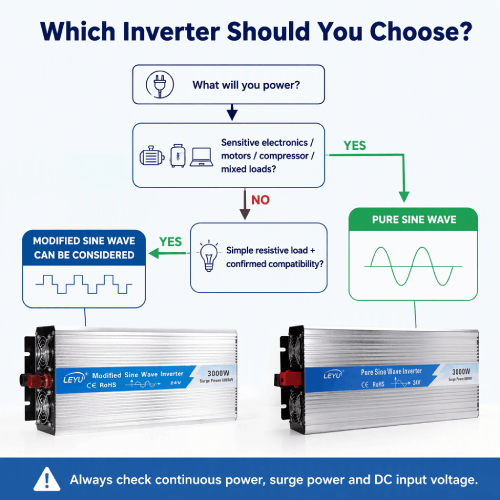
The best choice depends on your specific power supply requirements.Choose a pure sine wave inverter if:
- You need to power sensitive electronic equipment
- Your system includes refrigerators, water pumps, or compressors
- You are using devices with digital or electronic controls
- Low electrical noise is required
- You need to power a variety of different appliance types
- You anticipate needing to support more devices in the future
- The connected equipment is high-value or mission-critical
- You are building a professional off-grid or backup power system
Consider a modified sine wave inverter if:
- The load is simple and straightforward
- The equipment manufacturer confirms compatibility
- The application does not involve sensitive electronic equipment
- Occasional noise or slight performance degradation is acceptable
- Initial cost is the primary consideration
- It is for basic or temporary power supply scenarios
FAQ
Q:Are pure sine wave inverters better than modified sine wave inverters?
A:Pure sine wave inverters provide cleaner AC output and broader device compatibility. They are generally better suited for sensitive electronics, motors, compressors, and equipment with electronic control systems. Modified sine wave inverters remain suitable for applications involving simple loads where cost is a primary concern and compatibility has been verified.
Q:Can modified sine wave inverters damage electronic devices?
A:Some devices operate normally on modified sine wave power, while others may experience overheating, noise, interference, or operational issues. Compatibility depends on the device's design; therefore, you should consult the manufacturer's power requirements.
Q:Do refrigerators require a pure sine wave inverter?
A:Using a pure sine wave inverter is generally recommended for refrigerators, as they contain compressor motors and increasingly utilize electronic control systems. Additionally, the inverter must provide sufficient surge (starting) power to handle the compressor's startup requirements.
Q:Can I use a modified sine wave inverter to power a laptop?
A:Some laptop power adapters work with modified sine wave power, but compatibility varies by device. For computers and other valuable electronics, pure sine wave inverters offer broader compatibility.
Q:Is a pure sine wave inverter worth the extra cost?
A:For systems powering modern electronics, motors, mixed-load appliances, or valuable equipment, the additional cost buys better compatibility and system flexibility. For simple, known loads, a modified sine wave inverter may still be a cost-effective choice.
Q:What size inverter do I need?
A:Calculate the total load running simultaneously and check the startup surge requirements for motors, compressors, and similar equipment. The inverter should provide sufficient continuous and peak power, with an appropriate design margin.
