


-134213.jpg)
What Size Power Inverter Do I Need? Sizing Guide for Distributors
Date:2026-10-08 01:15:16 Visit:3
Core Terms: Continuous Watts vs Surge (Peak) Watts
Before sizing an inverter, buyers must distinguish two core ratings printed on every inverter datasheet:
- Continuous Wattage: The maximum stable AC power the inverter can deliver continuously under rated temperature and ventilation.
- Surge / Peak Wattage: Short duration burst power to start inductive motor loads with compressors, including refrigerators, water pumps, air compressors and power tools. Most inductive motor loads draw 2-3× their running wattage for 0.1-10 seconds during startup.
The correct inverter must satisfy both continuous wattage for simultaneous running loads and surge wattage for the largest motor startup. A 20-30% safety headroom is standard practice for commercial and industrial projects to account for temperature derating, cable losses and future load expansion.
Step-by-Step Inverter Sizing Calculation for Buyers & Distributors
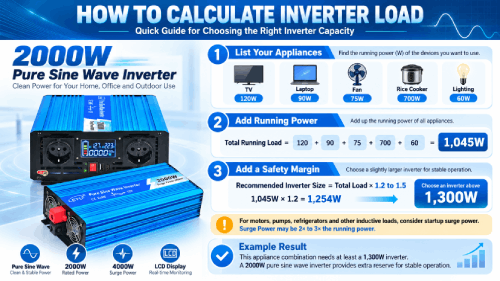
Follow this 5 step workflow to calculate the minimum inverter capacity for any project.
Step 1: List all loads running at the same time
Record every device that will operate simultaneously. Only include equipment turned on together; do not add loads that run alternately. Collect each device’s running wattage and startup surge wattage from nameplates.Step 2: Sum total continuous running watts
Add the continuous wattage of all simultaneous loads. This number is your base continuous load.
Step 3: Identify the highest single surge wattage
Find the maximum startup surge value among all motor-driven equipment. Usually only one large motor starts at a time, so you only need to cover this single peak surge.Step 4: Add safety headroom (20%–30%)
Multiply total continuous watts by 1.2 ~1.3 for safety margin. High temperature, poor ventilation and high altitude derate inverter output, so extra reserve prevents overload trips.Step 5: Match to standard inverter model ratings
Select the standard inverter specification that is closest to the requirements, with a continuous rating of ≥ the calculated continuous load and a surge rating of ≥ the maximum start-up surge.
Practical Sizing Example
A commercial off-grid cabin runs:- LED lights: 120W continuous, no surge
- Security NVR & cameras: 180W continuous, no surge
- Refrigerator: 150W continuous, 900W surge
Max surge = 900W
With 25% headroom: 330 ×1.25 = 412.5W continuous requirement
Final selection: 1000W continuous pure sine wave inverter with ≥2000W surge capacity.
Limitations of This Sizing Method
This selection guide is intended for standard single-phase off-grid and standby power systems. It does not cover grid-tied hybrid inverters, high-frequency industrial drives or equipment subject to frequent start-stop cycles. For such applications, please consult a power systems engineer.Key Application Sizing Reference for Distributors
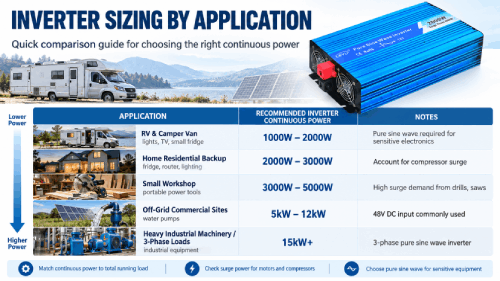
Purchasers and distributors often need quick access to information on common end-user application scenarios. These benchmark figures can help you speed up the process of requesting and preparing quotations:
|
Application |
Recommended Inverter Continuous Power |
Notes |
|
RV & camper van (lights, TV, small fridge) |
1000W - 2000W |
Pure sine wave required for sensitive electronics |
|
Home residential backup (fridge, router, lighting) |
2000W - 3000W |
Account for compressor surge |
|
Small workshop with portable power tools |
3000W - 5000W |
High surge demand from drills, saws |
|
Off-grid commercial sites, water pumps |
5kW – 12kW |
48V DC input commonly used |
|
Heavy industrial machinery / 3-phase loads |
15kW+ |
3-phase pure sine wave inverter |
For sensitive electronics, medical equipment, pumps and motors, always recommend pure sine wave inverters. Modified sine wave inverters cause harmonic distortion, overheat motors and damage precision devices.
What Happens If You Pick the Wrong Inverter Size
Choosing an improperly sized inverter creates headaches for your end users and increases your after-sales workload and return rate.
- Undersized inverter: Frequent overload trips, sudden shutdown during motor startup, accelerated component burnout, more warranty claims and product returns.
- Oversized inverter: Higher upfront procurement cost, increased standby idle power consumption, requirement for heavier DC cabling and larger fuses, leading to unnecessary wasted system investment.
Extra Factors That Change Inverter Size Selection
Wattage alone is not enough. B2B buyers should evaluate these parameters before final procurement:
1. DC input voltage: 12V for low-power small systems; 24V for mid-range; 48V for high-power commercial/industrial inverters. Higher DC voltage reduces DC cable current and wiring loss.
2. Environment derating: High ambient temperature, sealed cabinet installation and high altitude reduce real output capacity. Add extra margin for desert, marine and enclosed cabinet deployments.
3. Power factor & kVA rating: For industrial inductive loads, check kVA rating and power factor instead of only watts. Low PF loads increase apparent power demand.
4. Battery matching: The inverter size must align with battery bank voltage and capacity. An oversized inverter paired with a small battery leads to excessive DC current and cable overheating.
Why LEYU Power Inverters Are Preferred by Wholesale Distributors
Stable surge withstand capability: Reliable 2–3 times peak surge capacity to meet the start-up requirements of motors and compressors
- Wide operating temperature range with minimal derating in harsh environments
- Comprehensive protection: overload, overvoltage, undervoltage, overheat and short-circuit protection
- Customisation options: OEM/ODM support for distributors, with a long service life and consistent batch quality
- Global certifications for the EU, North American and Australian markets
